
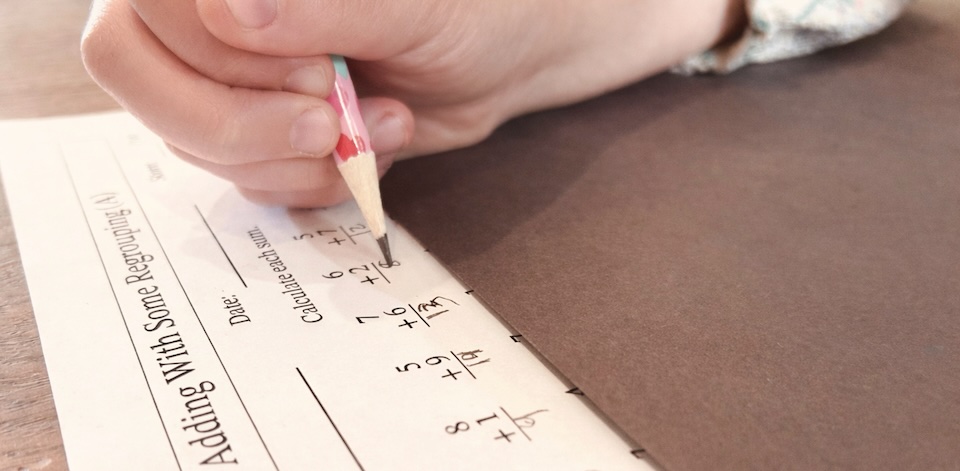
Our daughter is smart. She has had amazing speech and recall since she was a toddler. She was excited to start school and it came naturally to her. Which is why we couldn’t understand why she struggled with her math so much a few years back.
“I don’t know what to do,” she would say in frustration, staring blankly at her page of math problems. We would walk her through a problem and she would show us just how well she could do it. But on the very next problem, she would say it again: “I don’t know what to do.”
She wasn’t trying to get out of doing the work. She genuinely wanted to make progress, but there was something blocking her.
After some trial and error, we started to think about the problem a bit differently. What if it wasn’t the steps of adding big numbers together that was the problem? She clearly knew how. What if the problem was that she simply didn’t know where on the page to work next? Of course, she was used to working left to right, top to bottom, but perhaps so many problems was too much of a distraction to a young mind that may already struggle with distraction.
We talked it through with her and learned that, yes, there was too much to think about on the page. Too many directions she could go.
So, we came up with a simple solution: give her a piece of black construction paper to cover up the rows she wasn’t working on. Suddenly, she could concentrate and get her work done without intervention.
She’s grown a lot since then and no longer needs this aid. In fact, she only needed it for a year before she could manage without it.
The point is not that this solution is groundbreaking or that it will work for your child. The point is the luxury of experimentation and one-to-one coaching we can provide our kids when we homeschool. There have been so many times in our children’s education that we have had to assess and try to solve a problem with creativity.
I don’t mean to say students can’t or never get this attention in public or private school settings. Teachers are trained to educate, so they have resources and abilities to create successful learning plans. But they don’t always have the time that some students require. Despite how smart all of our kids are, I worry that at certain points in their learning, they would get left behind.
I personally struggled with Math in middle school. However, I was fortunate to have a grandmother who was a retired school teacher. My parents setup dates for me to go to her house after school, where we would sit at her kitchen table with two cookies, a cup of juice, and Math. That probably sounds like a familiar setting if you, too, are a homeschool family. That kitchen table, with the guidance of someone who cares deeply about your success, can mean so much.
And, of course I had plenty of teachers who cared about my success. But it wasn’t their kitchen tables where I sat for hours.
So, take advantage of this luxury. Try to see the problem from your child’s perspective. It doesn’t always mean you have to buy another program, or a tutor (which we tried). Sometimes, it only takes patience, empathy, and a piece of construction paper.